
The family tree of the Finnish Progen
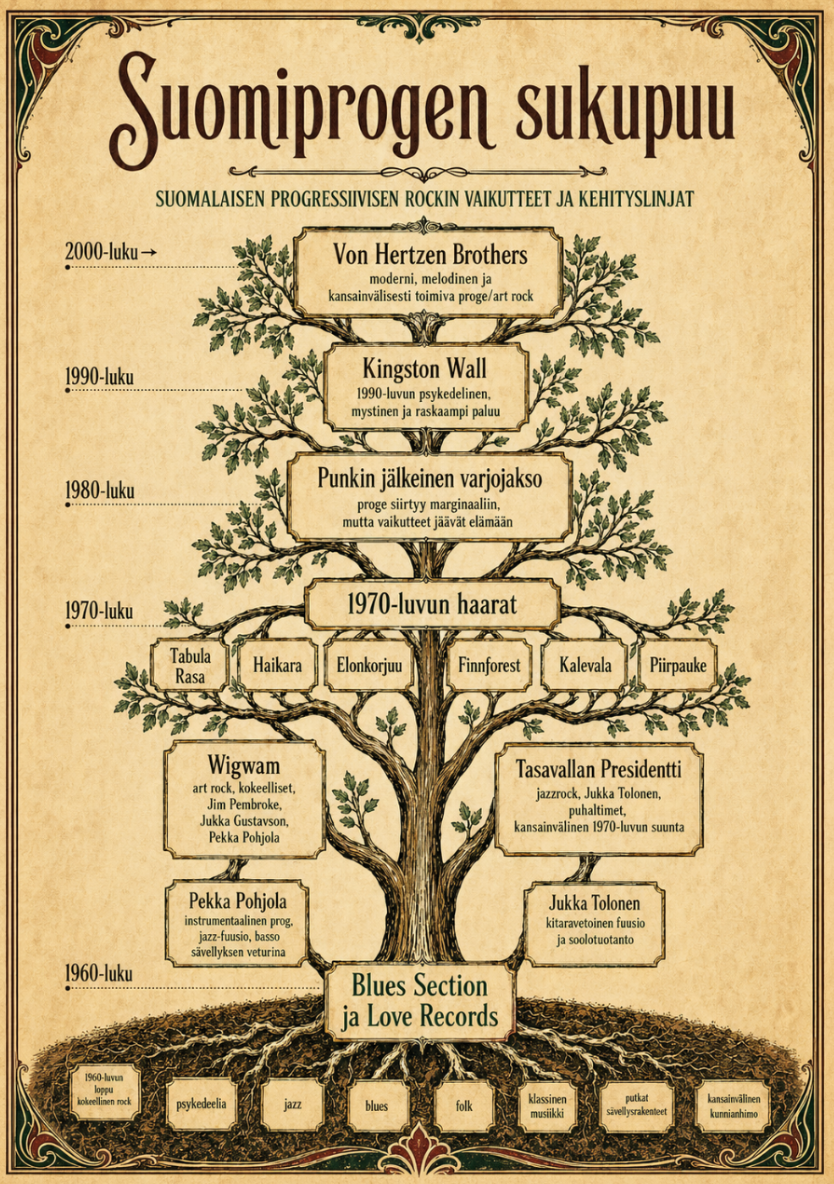
The family tree of the Finnish Progen
The origins of Finnish prog date back to the late 1960s, when rock began to break away from cover songs, the straightforwardness of dance halls, and the formulas of chart-topping pop. At the time, the word “progressive” signified ambition: long structures, shifting time signatures, literary or socially conscious lyrics, and influences from jazz, classical music, psychedelic rock, blues, and folk. In Finland, this shift was particularly concentrated around Love Records, where rock was allowed to be experimental, political, artistic, and even a bit challenging.
The first clear starting point was Blues Section, whose brief career gave rise to two pillars of Finnish prog: Wigwam and Tasavallan Presidentti. Wigwam steered prog toward keyboard-driven, vocal-heavy, and at times British-style art rock. Jim Pembroke brought international songwriting to the band, Jukka Gustavson added organ-driven intellectual tension, and Pekka Pohjola gave the bass a melodic, almost compositional role. Tasavallan Presidentti, on the other hand, took the path of jazz rock: Jukka Tolonen’s guitar, the horns, and the rhythmic fluidity made it one of the early leading bands of Finnish fusion.
The 1970s were a period of rapid growth for Finnish prog. Alongside Wigwam and Tasavallan President, bands like Tabula Rasa, Haikara, Elonkorjuu, Finnforest, Kalevala, and Piirpauke rose to prominence. For them, prog wasn’t just an imitation of the British model, but a Finnish blend of forest, city, jazz, folk music, quirky humor, and the musicians’ ambition. The albums were often complete works, not just collections of songs: the covers, titles, lyrics, and long instrumental passages built a world of their own. That is why Finnish prog feels more like a map than a genre. One branch features the discipline of a jazz club, another the cyclical nature of folk music, and a third the stubborn desire for freedom of young rock. Pekka Pohjola’s solo work continued this in its own unique instrumental vein, where the bass didn’t just support the song but carried the story.
After punk, prog was easily labeled as pretentious, but it didn’t disappear. It went underground, changed its clothes, and returned in the 1990s as a psychedelic cult force in Kingston Wall. The trio of Petri Wallin, Jukka Jylli, and Sami Kuoppamäki blended Hendrix, Eastern tones, mysticism, and heavy rock with the Finnish tradition of twilight. Kingston Wall was like a more dangerous descendant of old-school prog: less academic, more electricity, trance, and the mythology growing on the city’s outskirts.
In the 2000s, this legacy continued with even brighter and grander harmonies in the Von Hertzen Brothers, where classic prog, hard rock, folk influences, and stadium-scale melodies come together. At the same time, the Von Hertzen Brothers make it clear that prog isn’t just a museum piece, but a way of thinking about music as a larger structure: a song can be a story, a landscape, and a technical showcase all at once. Thus, Finnish prog comes full circle: from the margins to ambition, from underground clubs to international art rock that makes no apologies for its length, twists, or strange ideas.
The Suomiprogen Family Tree
Blues Section and Love Records
→ Wigwam: art rock, keyboards, Jim Pembroke, Jukka Gustavson, Pekka Pohjola
→ Pekka Pohjola: instrumental prog, jazz fusion, bass as the driving force of the composition
→ President of the Republic: jazz rock, Jukka Tolonen, horns, international 1970s sound
→ Jukka Tolonen: guitar-driven fusion and solo work
→ 1970s subgenres: Tabula Rasa, Haikara, Elonkorjuu, Finnforest, Kalevala, Piirpauke
→ The post-punk shadow period: prog moves to the margins, but its influences live on
→ Kingston Wall: A psychedelic, mystical, and heavier return in the 1990s
→ Von Hertzen Brothers: modern, melodic, and internationally active prog/art rock