

Bark boat and instructions:
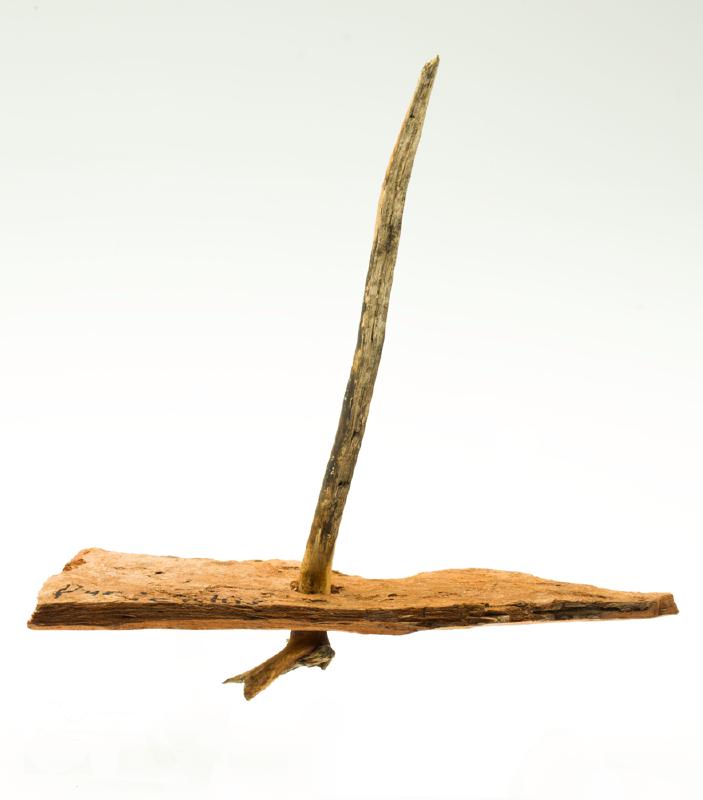
A bark boat is a traditional homemade children’s toy. Its exact origins are difficult to pinpoint, as it is part of a practical play tradition: children made it themselves, floated it in a ditch, stream, on the shore, or in rainwater, and then took it apart or lost it after playing. Such toys rarely ended up in collections in the same way as store-bought dolls, tin soldiers, or factory-made cars.
The history of the bark boat dates back to a time when children’s toys were often made from materials found in the immediate surroundings. The forest, yard, beach, and woodshed provided the raw materials: bark became a boat, pinecones became animals, branches became swords, and sticks became masts. The value of a toy wasn’t in its durability, but in the fact that you could make it yourself and launch it right away.
In Finland, bark boats are particularly associated with pine. Pine bark is light, buoyant, and fairly easy to carve. That is why it is well-suited for the hull of a small boat. In the traditional model, the hull is made of bark, the mast of a stick, and the sail of birch bark, a leaf, or paper. UPM Metsä’s instructions list pine bark, a stick for the mast, birch bark for the sail, as well as a knife, scissors, and a nail or screw for making the hole in the mast as the basic materials for a bark boat. The same instructions remind readers that bark and birch bark should not be torn from living or dead trees, but rather that pieces that have fallen to the ground or material collected with the landowner’s permission should be used.
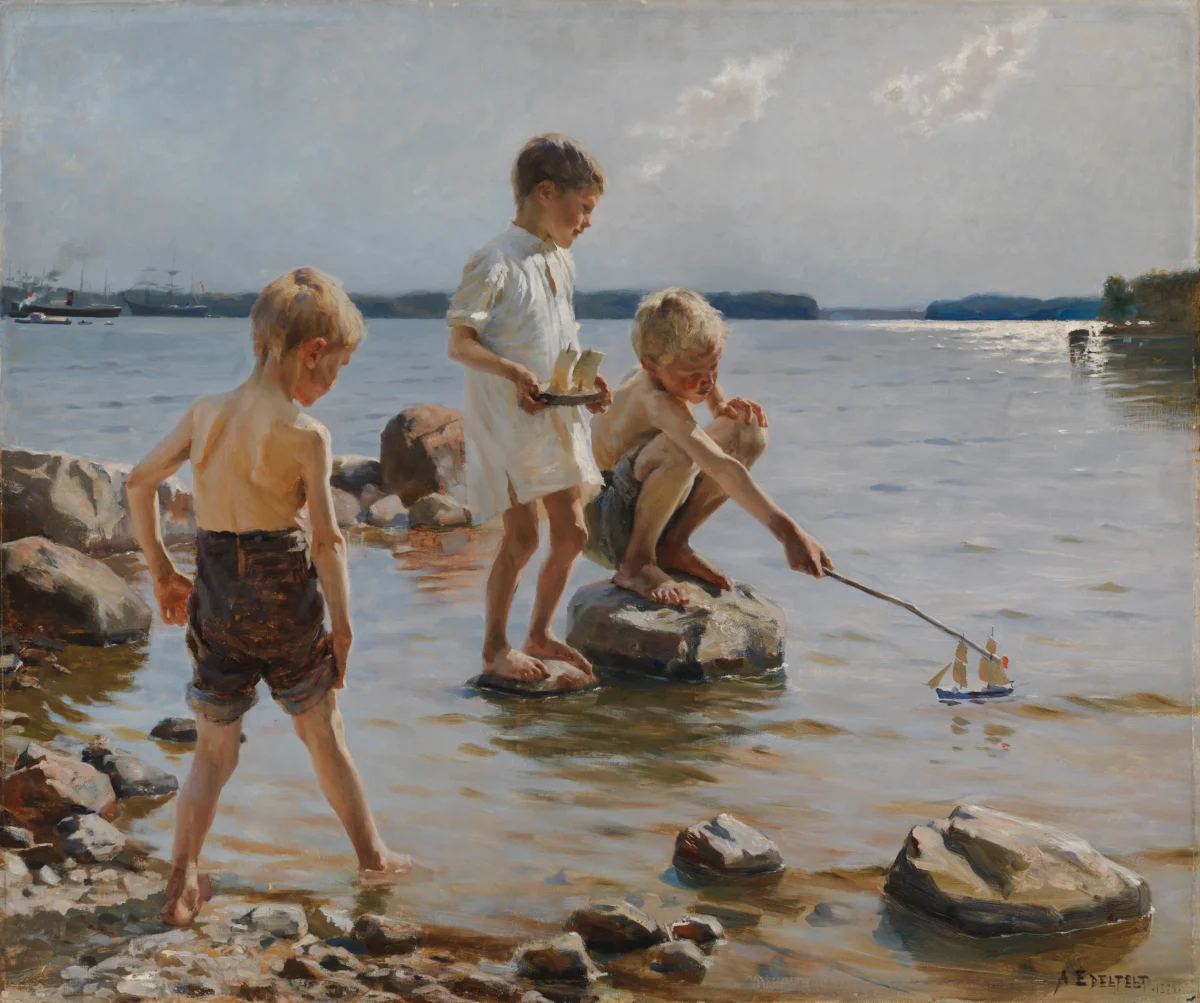
The bark boat also appears in Finnish visual art. Albert Edelfelt’s 1884 painting Boys Playing on the Beach depicts children playing on the beach at a time when homemade toys were a common part of childhood. The work is not a manual for bark boats, but it serves as a good cultural-historical reference to how children’s water games and the beach environment have been part of the Finnish visual tradition since the 19th century.
In museum collections, bark boats are often only featured when there has been a conscious effort to preserve the tradition. The KAMU Espoo City Museum’s collection includes a bark boat made in 2014, which was preserved as part of the TAKO museum collaboration in a project exploring children’s and young people’s relationship with nature. The object was part of the “Exploring Marine Nature” day camp at Villa Elfvik’s Nature House, where children carved and floated bark boats.
From a design perspective, a bark boat is a small but practical design challenge. The hull must float, the mast must stay upright, and the sail must be the right size. If the mast is too tall or the sail too large, the boat will capsize. If the hull is too narrow, it won’t stay stable. That’s why a bark boat teaches the logic of materials, balance, and experimentation without using technical terms.
Today, the bark boat serves as a traditional game, a nature education activity, and a simple craft project. It requires no pre-made parts or special skills, but it combines natural materials, hands-on work, play, and testing its functionality.
Instructions:
Materials:
pine bark, a small stick for the mast, a leaf, paper, or a piece of straw for the sail, a pocketknife or knife, scissors, and a nail, screw, or thumbtack to make a hole.
- Choose a suitable piece of bark for the trunk.
Preferably use bark found on the ground or ready-made craft materials. Do not tear bark from a living tree. - Shape the hull.
Carve a boat-shaped piece from the bark. The bow can be slightly pointed, and the stern flatter. Don’t make the bottom too narrow, so the boat stays upright. - Drill a hole in the mast.
Use a nail, screw, or awl to make a small hole in the center of the frame. If you’re working with children, this step should be done under adult supervision. - Make a mast.
Carve or cut a stick to the right length. Carefully push it into the hole. - Add a sail.
Cut a small sail out of paper, a magazine, or bark. Make two holes in it and thread it onto the mast. - Test the buoyancy.
First, lower the boat into a basin, a bucket, or shallow water. If it capsizes, reduce the sail area or shorten the mast.
7. Launch the boat.
The best place is a shallow beach, a stream, or a test dock built in a pond. You shouldn’t leave a sail or other loose material in the water once you’ve set it out in nature.