

Fiskars Village
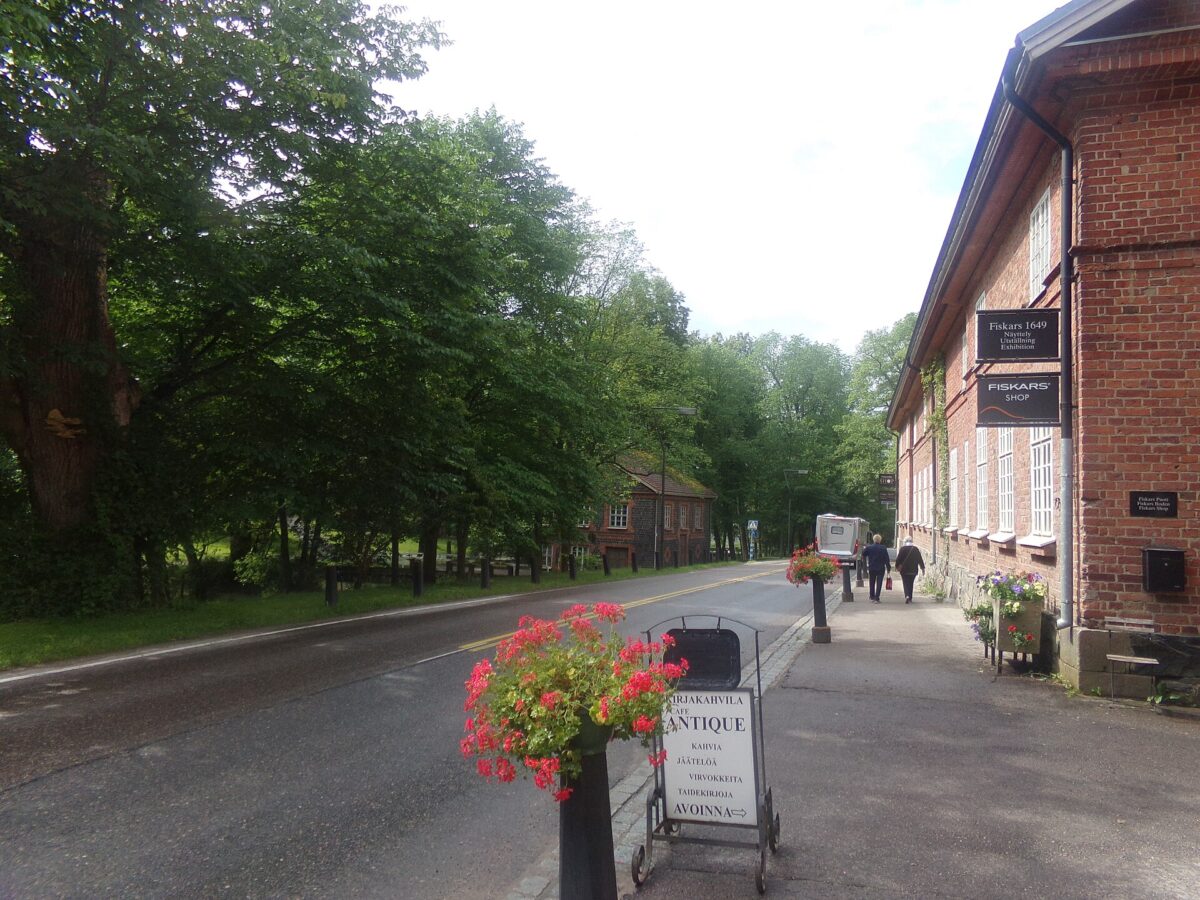
Fiskars Village is located in Raasepori, in the former municipality of Pohja. The village’s history dates back to 1649, when Peter Thorwöste was granted permission to establish a blast furnace and a hammer mill in Fiskars. The location was chosen for practical industrial reasons: the Fiskars River provided hydropower, the forests yielded charcoal, and waterways connected the ironworks to wider trade networks.
The ironworks’ production evolved over the centuries. By the late 18th century, copper was also being processed in the area, and during the 19th century, under Johan Jacob von Julin, Fiskars focused particularly on the further processing of iron. According to Fiskars, Finland’s first fine-blacksmithing workshop was established in the village in 1832, where production expanded to include items such as forks and scissors. In 1837, Finland’s first machine shop was founded, which was also an early manufacturer of steam engines on an international scale.
A lesser-known detail of Fiskars’ industrial history concerns ironworks tokens. The National Museum of Finland’s collections include a Fiskars ironworks coal token dating from the 19th century. The letters “AFT” on it refer to the ironworks at Antskog, Fiskars, and Trollshovda. The token was used as an internal means of payment for charcoal suppliers, likely after the mid-19th century. This provides concrete evidence of how the ironworks’ production was based on a system of materials, labor, and local trade.
Today, Fiskars Village is known as a hub for design, crafts, art, restaurants, and events. The transformation began in earnest in the 1990s, when, as industrial activity declined, old buildings were renovated into workshops, studios, and apartments for craftspeople, designers, and artists. The first art exhibitions were held in 1994, and later the Onoma cooperative of Fiskars artisans, designers, and artists was founded.
What makes Fiskars so fascinating is its continuity. The same village has served first as a center of the ironworks industry, then as a hub for the manufacture of Finnish household goods, and today as a design and cultural destination. The old industrial structure has not been reduced to mere scenery; instead, its spaces have given rise to new production, exhibitions, studios, shops, and events.