

Finnish ryijy
A ryijy is a pile-woven woolen textile whose earliest uses were related to warmth and shelter. It was not originally a wall decoration, but rather a blanket used, for example, on sea voyages as a cape and sleeping blanket. The woolen pile surface also provided warmth in damp conditions, which is why the ryijy was a practical textile before it became a decorative treasure.
Ryijy rugs have certainly been known in Finland since at least the mid-15th century. Olavi Niilonpoika, the commander of Häme Castle, is known to have owned a ryijy rug at that time. From castles and manors, ryijy rugs gradually spread to the homes of the bourgeoisie and the peasantry. The earliest ryijy blankets were thick and warm, and they were used with the pile side facing the sleeper.
In the 18th century, the ryijy became a versatile textile used for celebrations and formal occasions. It was used at weddings as a wedding veil, as a dowry, as a bedspread, and at funerals as a shroud or burial cloth. During the golden age of folk ryijy, from the late 18th century to the early 19th century, the patterns on ryijy featured a wealth of symbolic motifs, such as crosses, trees of life, hearts, hourglasses, animal figures, and human figures.
After the mid-19th century, the use of ryijy as a blanket declined as quilted blankets became more common. In the early 20th century, the National Romantic movement brought ryijy back into the spotlight. Old utility textiles began to be valued as part of Finnish craft heritage, and artists and textile designers developed the ryijy into a modern art textile. A well-known example is the Liekki ryijy designed by Akseli Gallen-Kallela, which was part of the interior design of the Finnish pavilion at the 1900 World’s Fair in Paris.
Today, the ryijy is recognized both as a traditional craft and as a form of textile art. Its history tells the story of an object whose significance has evolved from that of a practical blanket to that of a ceremonial item, a commemorative textile, a wall hanging, and a work of art.
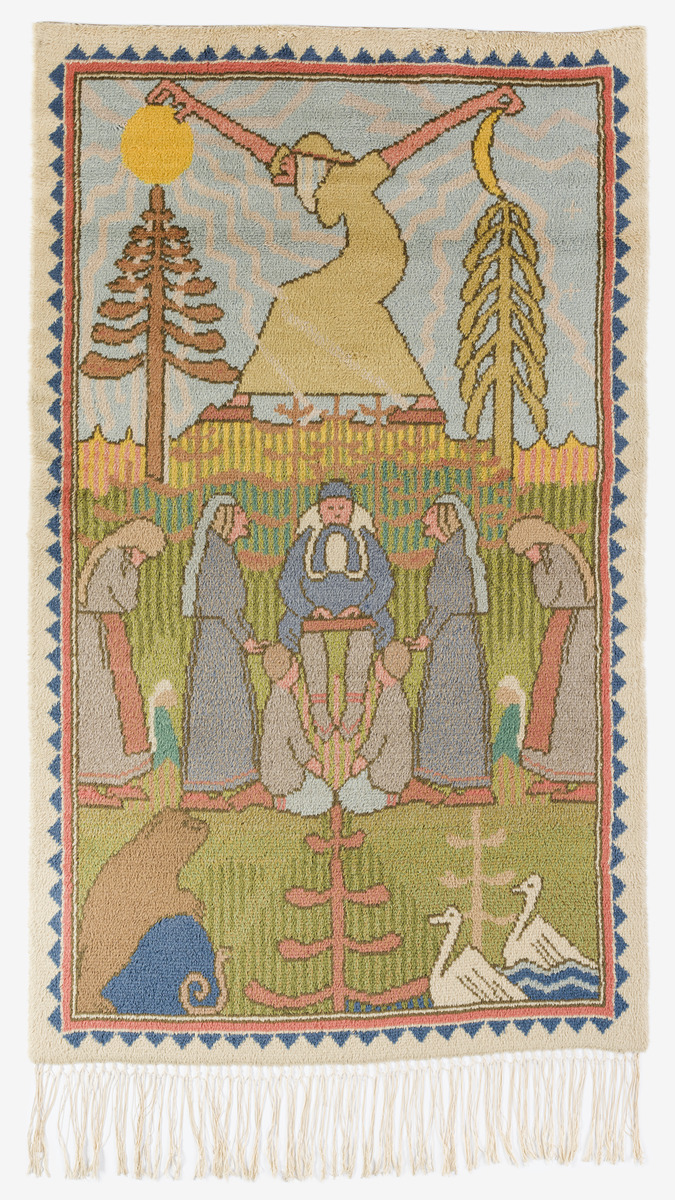
This Kalevala-themed ryijy is a woolen textile produced by the Roine School of Handicrafts and Applied Arts and designed by Otto Joseph Alasen between 1908 and 1913. The ryijy was woven on a loom, and its motif is based on the Kalevala tale of Louhi, who takes the sun and moon from the sky and hides them under a rock.
At the top of the composition, Louhi reaches toward the sun and the crescent moon. Below her are the grieving people of Kaleva, Väinämöinen playing the kantele in the center, and two white swans at the bottom. The bottom edge of the rug features long fringes, and its color scheme consists of muted shades of blue, gray, and green.